
Business call forwarding
Keep Your Business Number: Forward the Calls You Miss
Your number is already on the van, the website and your customers’ phones. You may be able to keep it exactly where it is and send only the calls you cannot answer to a separate message service.
Mobile or landline: choose the answering route
If you are looking for a mobile answering service or a landline answering service, separate two decisions: how the call reaches the service and what happens when it arrives. Forwarding handles the route. A person, voicemail or another agreed system handles the conversation or message.
| Your current number | Ask about the route | Test the customer experience |
|---|---|---|
| Business mobile | Which no-answer, busy and unreachable diverts your account supports, and how forwarded calls are charged. | Answer normally, let a call ring out, then test busy and unreachable conditions separately. |
| Landline or digital business phone | Which product controls diversion, how it interacts with voicemail and call waiting, and the cost of the forwarded call. | Check no-answer and engaged calls independently; do not assume both reach the same greeting or service. |
EE Business explains conditional and unconditional mobile diverts and how its tariff affects forwarded-call charges. That is one provider’s arrangement, not a rule for every network. For BT Digital Voice for Business, see the separate busy and unanswered call checks below.
Then choose who answers
A staffed service may suit callers who need a conversation at the time. Voicemail and transcription may suit enquiries you can review at a realistic break. A text reply is a separate messaging workflow, with its own number and delivery checks. Use the answering-service comparison to choose the destination, then test this forwarding route with your provider before depending on it.
You do not need to assume that keeping a number means keeping every existing phone setting. Record the original configuration and the reversal steps. Forwarding should be agreed for your exact account; this guide is not a universal setup code or a promise of compatibility.
Ask for conditional call forwarding
Conditional forwarding routes a call when a particular condition is met, such as no answer or a busy line. Unconditional forwarding sends every call elsewhere. If you still want to take calls yourself when you are free, make that distinction clear when discussing the setup with your phone provider.
EE Business documents both types. The controls available on your handset and account vary, so a general “call forwarding” switch may not provide all the conditions you need. Ask specifically about no-answer, busy and unreachable calls rather than assuming one switch covers all three.
What the customer experiences
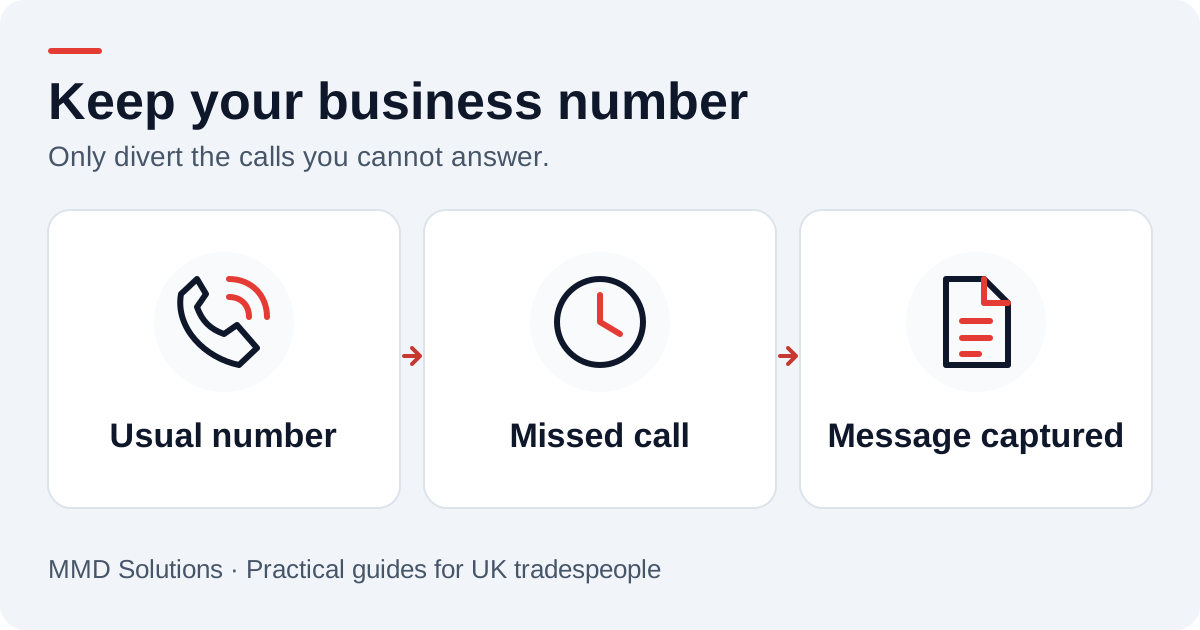
The public number stays familiar. Behind it, the destination can capture a message and pass the enquiry to your callback list or CRM. We agree the greeting, what information to request and who receives the result. If you answer the original call, that call should not also become an unanswered-call enquiry.
Forwarding is different from porting, which moves the number between providers. A forwarding pilot can let you try the workflow before deciding whether a larger phone-system change is useful.
Four questions for your phone provider
- Can this account divert unanswered, busy and unreachable calls separately?
- What ring delay can we choose before the no-answer divert starts?
- What charges apply to the forwarded leg, and are those calls included in my allowance?
- Will the original caller number reach the destination, and how do I restore the old voicemail?
Ask about your exact tariff. A destination’s number rental and incoming-call charge do not tell you what the original mobile provider will charge for forwarding. Keep the two sets of charges separate when comparing costs.
BT Digital Voice: test busy and unanswered calls separately
BT’s Digital Voice for Business voicemail guide shows that an unanswered-call divert can leave engaged callers going to BT voicemail. A successful no-answer test does not prove that busy calls reach the same destination. See BT’s call-diversion examples on page 8 (PDF).
- No answer: let the phone ring, then confirm the greeting and destination.
- Busy: make a second test call while the line is in use; record which service answers.
- Call waiting: check how it interacts with both routes before relying on the setup.
Record the original settings and ask your provider to confirm the arrangement for your exact product. BT’s current Digital Voice help is a starting point; settings for Cloud Voice Express, Smart Divert and other systems differ. This is a routing check, not a promise that every line can connect to MMD.
Test the route before telling customers
- Call from a different phone and answer normally.
- Let it ring unanswered and listen to the full greeting.
- Test a busy line and an unreachable phone if those conditions are enabled.
- Leave a made-up job enquiry and check that the number, message and owner arrive together.
- Return the call and check which business number the customer sees.
- Restore the original settings once so you know how to reverse the change.
Avoid forwarding a number back to itself through another service. Record the original settings before making changes. Use your provider’s current instructions rather than copying dial codes from a guide for a different network.
Connect the message to the way you work
Once the phone route works, the useful question is where the enquiry goes. An office team may want it beside an existing customer record; a sole trader may need a short callback list. Our voicemail-to-CRM guide explains that handover, and the greeting examples help you decide what callers should hear.
Sources and review
Decision guidance and linked next steps added 23 October 2026. The comparisons are MMD planning guidance, not measured customer outcomes or a claim that every provider supports the same setup.
BT Digital Voice clarification added and its linked guidance checked 19 October 2026. The provider example describes BT’s routing, not an MMD customer result.
Reviewed 17 October 2026. EE Business: managing call diverts.
The examples and checklists are written by MMD Solutions. Adapt the wording and working hours to your own business.
Plan the human follow-up too: use the free callback checklist and customer reply templates.