
Templates & tools
Unpaid Invoices: Payment Reminder Templates for UK Trades
An unpaid invoice is not always a customer refusing to pay. It may be waiting for an accounts contact, missing a reference, partly settled or caught in a dispute. Check that position before sending another payment reminder.
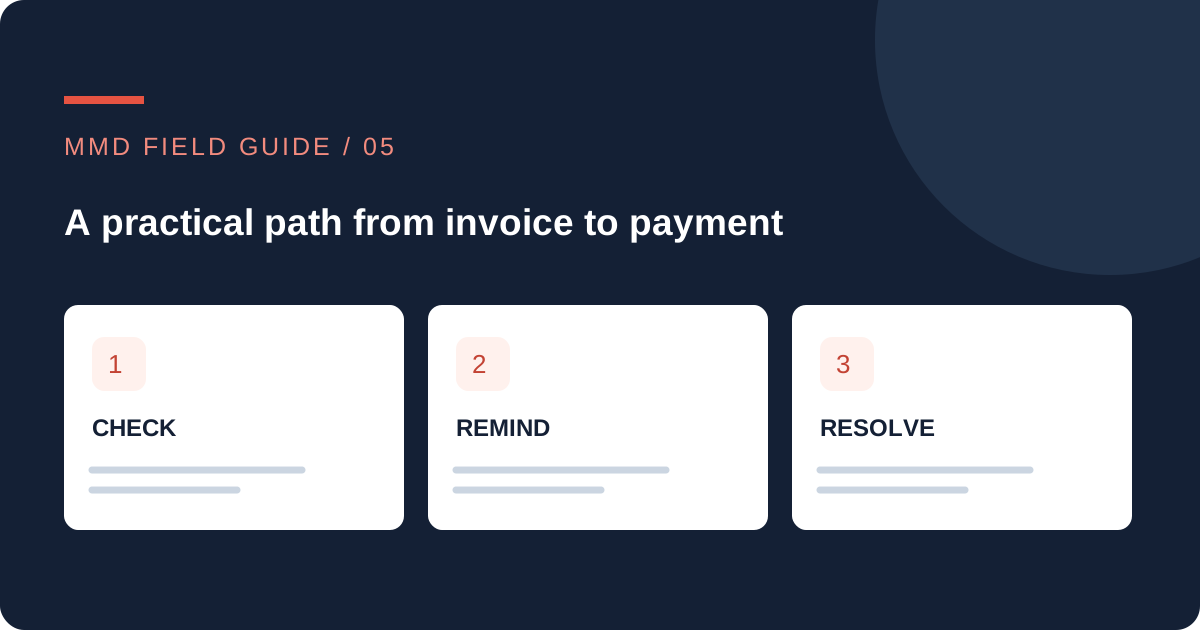
Check the record before chasing an unpaid invoice
Look at the issued invoice, the agreement, recent payments and the customer’s last reply. Does the amount match? Has the payment arrived under a different reference? Did the customer ask for an amended invoice that nobody sent?
For example, if an invented £108 invoice has a confirmed £60 part payment, the balance is £48. A reminder for £108 would be wrong. Keep the payment status and outstanding amount together so the next person does not have to reconstruct the position.
The Small Business Commissioner’s invoicing guidance highlights the importance of the right recipient, payment date and required purchase-order details. Those are sensible checks before treating a delay as an escalation issue.
Template 1: a straightforward first reminder
Subject: Invoice [reference] — payment update
Hi [name],
I’m checking invoice [reference] for [brief job description/site reference]. Our records show [balance] outstanding, with payment agreed for [date]. I’ve attached the invoice again for convenience.
Could you confirm whether payment has been arranged? If it has already been sent, please share the payment date or reference so I can check our records. If there is a query, let me know and I’ll look into it.
Thanks,
[name / business]
Use the wording only after checking those facts. Attach the correct version, and avoid putting unnecessary personal or access information into the subject line.
Template 2: ask for a definite next step
Subject: Follow-up on invoice [reference]
Hi [name],
I’m following up on my message of [date] about invoice [reference]. We still have [balance] recorded as outstanding.
Please confirm the expected payment date, or let me know what needs resolving before payment can be arranged. If somebody else handles this, could you direct me to the right contact?
Thanks,
[name / business]
Choose a follow-up interval suited to the agreement and conversation. These are wording examples, not a universal schedule. Repeated daily messages to somebody who has already explained a problem are unlikely to fix a broken handover.
Template 3: pause chasing and resolve a query
Subject: Query on invoice [reference]
Hi [name],
Thanks for explaining the issue with [specific point]. I’ve noted it against the invoice and paused our routine reminders while we review it.
[Responsible person] will check [record or question] and come back to you by [agreed date]. Please send [specific missing information, if needed] so we can resolve the point.
Thanks,
[name / business]
Only promise a review date someone can meet. Keep the original invoice, the query and any agreed correction together. If part of an invoice is disputed, have a person establish the appropriate next step rather than letting a reminder rule make that decision.
Business debts and household customers are different
GOV.UK’s late-commercial-payment guidance concerns one business paying another. It sets out when a commercial payment becomes late and the relationship with agreed terms. Do not automatically apply commercial interest or debt-recovery wording to a homeowner’s invoice. Read the current official guidance.
For a disputed or escalating debt, get advice appropriate to the contract and jurisdiction before threatening action or adding charges. These email examples are routine correspondence, not a letter before action or a debt-recovery service.
Policy watch: the government has published proposals through the Commercial Payments Bill overview. Check the live parliamentary record and commencement position before treating a proposed measure as an applicable rule.
What can a sensible reminder workflow do?
Start with the reminders already available in your accounting system. If a separate connection is justified, define exactly what it is allowed to use and what makes it stop.
- Use the current approved balance, not a copied total from an old spreadsheet.
- Exclude cancelled invoices and records under review.
- Pause when a reply, payment or arrangement needs checking.
- Route exceptions to a named person rather than silently failing.
- Keep an activity history so another team member can see what was sent.
Test those rules with fictional records before connecting real accounts. Include a part payment, a credit, a duplicate customer, a disputed invoice and an unmatched bank reference. A process that sends the wrong reminder faster has not solved the problem.
If missing invoice details are causing the delay, start with the invoice requirements and non-VAT sole trader example. Use the job sheet template to keep the work record and billing handover connected.
Common questions
Should a reminder include the whole job history?
Usually a clear reference and short description are enough to identify it. Provide relevant supporting details where a genuine query requires them.
Can reminders guarantee faster payment?
No. They can make the next action clearer, but cannot resolve every dispute or a customer’s inability to pay. Measure the actual outcome.
What should be connected to the invoice?
The billing customer, the approved work record, payment status and next action. Our invoice workflow example shows the handover in context.