
Business admin for UK trades
Managing Repeat Work from Landlords, Letting Agents & Builders
Repeat work is easier to organise when the organisation, the property and the individual job are kept distinct. A letting agent may request work, another person may approve it and a tenant may arrange access. A builder can have different site and accounts contacts. Keep those roles clear before a message becomes a booking.
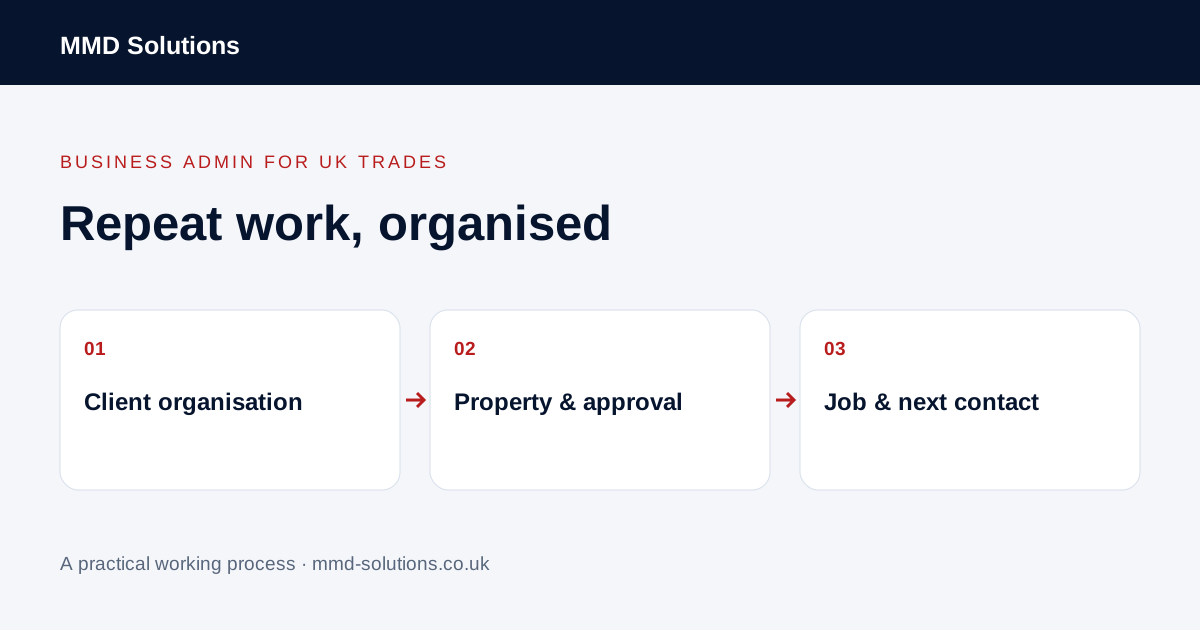
Separate the client from the property
Use three linked levels: the organisation you work for, each property or site, and each request/job. Keep the contact's role visible. A person who can arrange access is not necessarily the person who can approve a quotation or confirm payment instructions.
For an illustrative example, the same agency sends two repair requests at different flats. Give each request a job reference and property reference. Link both to the agency, then record the appropriate contact for each. Do not overwrite one property's details on a single generic “Agency job” record.
The customer-record guide explains the underlying structure. Here the focus is managing recurring requests and business relationships across that structure.
Agree the working process before requests build up
- Where should new requests arrive, and which details should accompany them?
- Who can approve a quote or requested change?
- What must be confirmed before a visit is booked?
- Who needs progress updates, and through which agreed channel?
- Which job/property reference should appear on documents?
- Where should the invoice go, and what supporting information is expected?
Record the process the client actually agrees to. Do not assume that every branch, property manager or building site operates the same way. If their instructions conflict, ask for clarification rather than automatically sending work to the last contact used.
Keep one working register of open requests
For each request, record its property, current position, next action and action owner. Distinguish a request for availability from an agreed visit. Likewise, distinguish a quote sent from permission to proceed. Those differences make the list useful when several jobs are moving at once.
| Position | Check next |
|---|---|
| Awaiting information | Exactly which detail is missing, and who was asked? |
| Awaiting approval | Which proposal/version is awaiting whose decision? |
| Ready to book | Are availability, access and approval all confirmed? |
| Work finished | What completion information and invoice handover remain? |
Keep evidence of agreed changes with the job. Use your client's appropriate secure process for access instructions and any personal information.
Make updates easy for the client to act on
A useful update identifies the job, the current position and anything needed from the recipient. It should not require them to piece together several unrelated messages.
After work, follow the agreed documentation and invoice process. Which? Trusted Traders' landlord guidance highlights communication, organisation and records as part of maintaining working relationships. Those are sensible habits; they do not guarantee a contract or a steadier workload.
Follow up on a reason, not a blanket schedule
Keep the next contact tied to an actual purpose: a decision on an outstanding request, an agreed review, or work the client has asked you to revisit. Record the last discussion so the owner does not contact someone with an irrelevant reminder after the matter is closed.
If your goal is winning new organisational clients, diagnose that separately. A tidy register can help you manage relationships you have, but it cannot create demand or guarantee approved-contractor status. Avoid turning a list of contacts into an unsolicited message campaign.
Download the repeat-client work register
Download the blank register (CSV)
Start with active requests. If your current software already links organisations, properties, approvals and jobs, use it rather than maintaining another list. Use the existing-software audit to check what you can already do.
Sources and review
Reviewed 23 October 2026. Which? Trusted Traders: getting regular work with landlords.
Source material supports the specific examples referenced. The checklists, worksheets and illustrative scenarios are MMD's suggested business-admin processes, not customer results. Product workflows can change; check current documentation for the software you use.