
Trade technology updates · Source briefing
Digital training for small builders: start with one useful change
CITB reports a funded digital training programme for small builders. The useful question for a busy trade business is which part of the learning could improve a real task—and what you need to check before investing your time.
What CITB reports
CITB describes a free digital training programme for small builders, supported through its Industry Impact Fund. Its announcement describes a three-month pilot involving 50 builders and a subsequent online course, delivered largely through video.
The CITB project summary describes learning about choosing technology, evaluating its fit and embedding it in business processes. It marks the funded project as complete, with a planned end date of 30 June 2026. That project status does not confirm whether new enrolment or live support is available now.
The announcement includes favourable participant outcomes but does not provide an independent estimate of the saving your business would achieve. We have not tested the course or verified the participants’ results.
What it means for your business
Training can help you ask better questions before buying software. For an owner who moves between enquiries, jobs and invoicing, a useful starting point is a task that repeatedly needs correction, retyping or chasing.
Look at a recent example: perhaps the same job address was copied into several documents, or a quote was waiting because nobody knew who should approve it. Write down the current steps, the information involved and who owns the next action. Then look for learning that helps with that specific process.
You may find that the software you already use has a suitable feature, or that a clearer handover is enough. A spreadsheet can also be an appropriate starting point. Our customer-record template shows a manual way to keep customers, properties and enquiries distinct.
Check access before signing up
Use CITB’s links to find the programme’s current provider information, including Solving Construction. Confirm these points directly before reserving time or paying for anything:
- Are the self-paced materials currently accessible, and who can use them?
- Does the offer include current coaching or live support, or recorded content only?
- What time commitment, accounts, equipment or software subscriptions are needed?
- Are there fees for any optional services or products after the training?
- Can you assess the material without sharing real customer information?
We confirmed the published source pages, not a registration or booking. Access terms may have changed since the announcement. MMD is not the programme provider and does not receive course registrations through this page.
Turn learning into a small practical trial
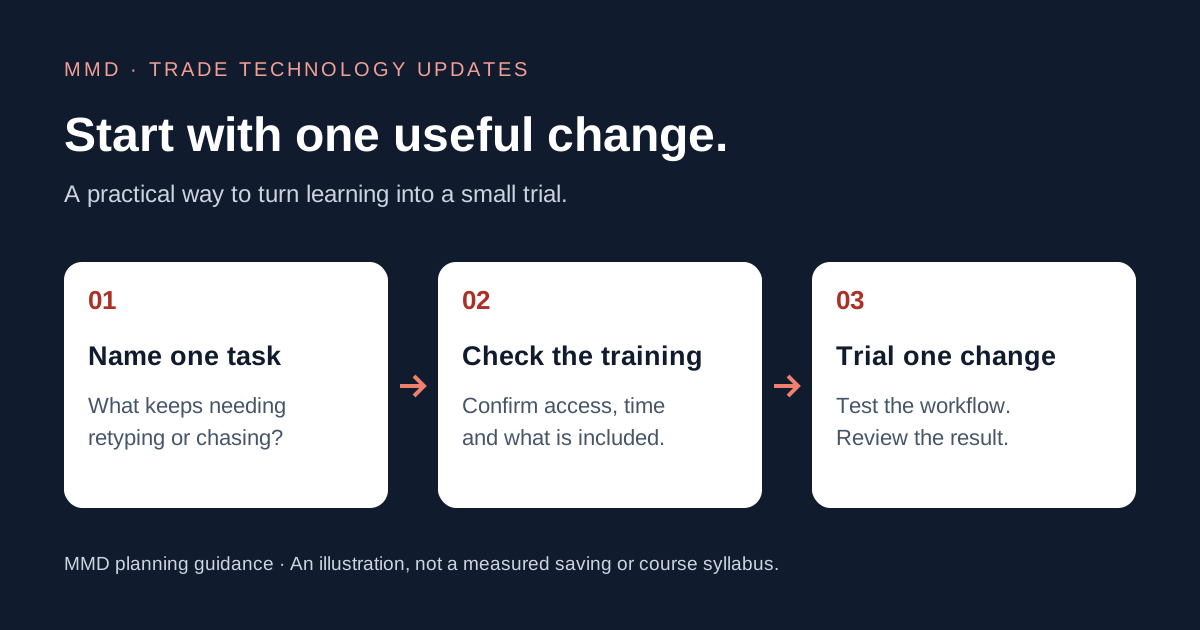
This is MMD’s suggested process, not the course syllabus or a measured customer result.
- Choose one task. For example, record a new enquiry once and give its next action a named owner.
- Describe the current problem. Keep a simple count of missing details, duplicate entries or follow-ups without an owner. Avoid collecting unnecessary customer data.
- Try the relevant learning with fictional records. Check the steps before using real enquiries. Keep a way to return to the previous process.
- Review the result. Compare the same type of task before and after. Include time spent checking errors, maintaining the process and training staff.
- Keep, adapt or stop. A change is useful if the team can operate it reliably. A demo alone does not establish a saving.
Use the enquiry information checklist to decide which details matter. For an estimate of potential capacity, the UK Trades Admin Report and editable model lets you examine assumptions; its scenarios are not guaranteed savings.
Sources and editorial notes
Sources checked 23 October 2026:
- CITB announcement: free digital training programme for small builders. The original publication date was not established from the accessible page.
- CITB project record: Solving Tech for Small Builders. Status and planned project dates are the provider’s record, not current course availability.
- Solving Construction, linked by CITB. Current registration, eligibility and any follow-on costs need checking with the provider.
CITB’s programme description is attributed above. The task selection, trial checklist and fictional example are MMD’s own practical analysis. This is MMD commentary, not an endorsement of MMD by CITB or the programme. To flag a correction, contact MMD with the source and detail.