
UK trades · evidence briefing · 2026
The work after
the tools go down.
What published UK research tells us about trade-business admin, where connected customer records could help, and how to estimate the time a better workflow might free up.
The case for improving admin is credible. A universal savings claim is not. These studies describe different populations and activities. They cannot be added together, and none measures MMD performance. Necessary quoting, safety checks and customer conversations still take time.
01 / A second working day
Admin is real work. Repeating it is the opportunity.
The NOW Report, jointly commissioned by Powered Now and Installer, gives a weekly mean of 320 minutes for tasks including quotes, invoices and payment follow-up. Fusion Insight & Strategy surveyed 140 UK tradespeople. It is a commissioned, self-reported sample, not a census or a measure of avoidable work. Source [1]
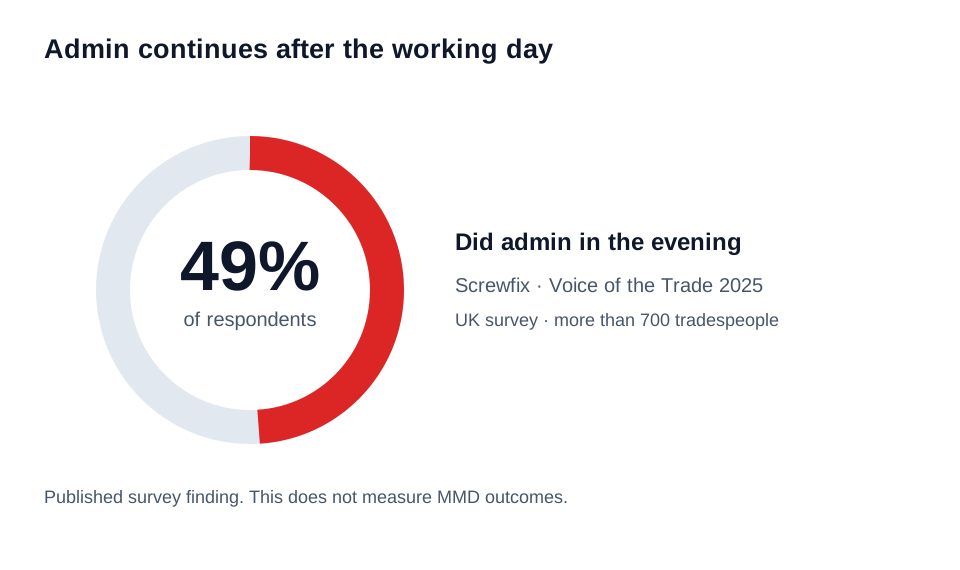
Screwfix’s separate 2025 publication draws on more than 700 UK tradespeople and reports that 49% did administration in the evening. Its sample includes sole traders and larger firms. Source [2]
For a plumber, electrician or small building firm, the useful question is specific: are you recording the same customer twice, searching for the latest quote, or recreating information that already exists?

Payment chasing is another distinct burden. DBT’s 2025 study estimates 86 staff-hours annually per business affected by late payment. That is UK business context across sectors and sizes—not a trades-only average. It supports examining follow-up, not a claim that reminders recover all debt or remove every chasing hour. Source [4]
02 / What digital adoption can help with
Time and customer organisation show up in the evidence.
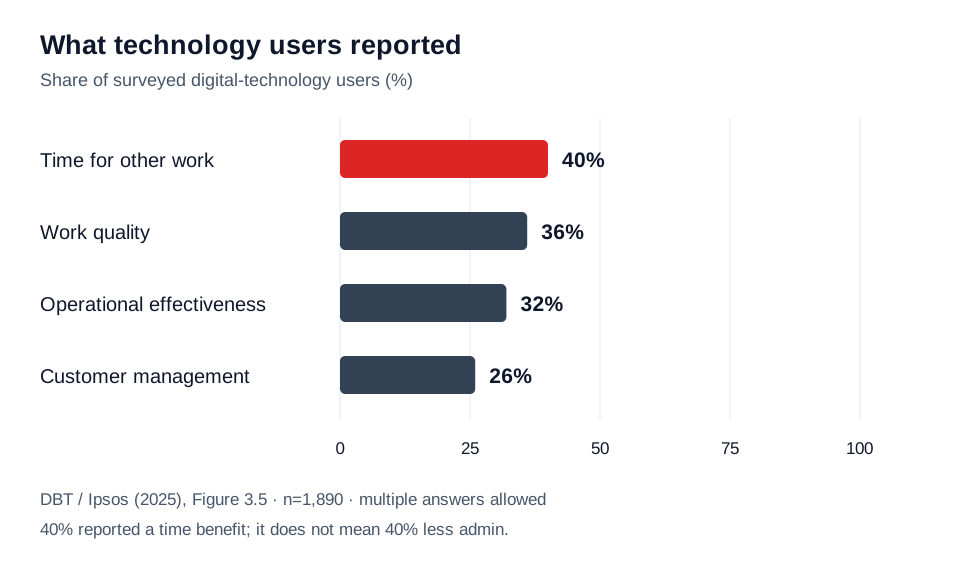
In DBT/Ipsos research, 40% of 1,890 surveyed SME technology users reported freeing time for other tasks; 26% reported better customer management. The question allowed multiple answers. These are reports of a benefit, not the size of the benefit. The sample excludes sole traders and covers digital tools generally, so it cannot be treated as a trades-only CRM result. Source [3]

View the chart data table
| Reported benefit | Respondents selecting it |
|---|---|
| Time for other tasks | 40% |
| Work quality | 36% |
| Operational effectiveness | 32% |
| Customer management | 26% |
03 / From the evidence to a practical workflow
One record. A clear next action. Less retyping.
Our interpretation is that connected records are worth testing where repeated handling is visible. A master customer record links a person or business to the correct property, enquiry and latest approved information. It does not mean every address is a separate customer, or that software should merge records without checking.
| Handover | Potential improvement | Human check |
|---|---|---|
| Phone message → callback | Turn a transcript into a task with an owner and the original context. | Check names, numbers, urgency and transcription errors. |
| Enquiry → customer record | Match an existing contact and attach the new request. | Confirm payer, occupier and property; resolve uncertain matches. |
| Quote → follow-up | Keep the latest version and a reminder in one place. | Approve scope and price; stop chasing when the customer declines. |
| Completed job → invoice preparation | Reuse approved customer and job details. | Confirm completion, materials, VAT treatment and payment status. |
The last three rows may need an existing CRM or job-management platform and a separately scoped connection. They are not all included in MMD’s Callback Standard plan. Quote follow-up and invoice reminders are optional paid additions; custom CRM connections are scoped separately. Explore customer master records, enquiry-to-CRM workflows and our illustrative trade workflows.
Start by using features you already pay for. If your current process is quick and reliable, another tool may add work rather than remove it.
04 / Build your own estimate
How much time could a repeated task free up?
Illustrative model · not a savings guaranteeCount repeatable actions, time one before and after, then subtract review and correction effort. Do not count the same handover twice. Use the model for one workflow or a carefully defined bundle of tasks—not your entire working day.
Editable workflow model
Defaults are invented planning inputs: 30 actions a week, 5 minutes before and 2 after, with 15 minutes weekly review. At 48 working weeks, that means 60 recurring hours freed; after 2 hours of initial setup or learning, the first-year estimate is 58 hours.
At an assumed £25 per hour, that represents £1,450 of time capacity. It is not an earnings forecast, an invoice you can send or a cash saving. Software, migration and other charges still need to be assessed separately.
This wider-workflow example is not an allowance included in the £49 Standard plan. The smaller call-capture example follows below.
Your inputs stay in this page. With analytics accepted, Google receives a calculation event and MMD receives a broad result band for daily counts. No entered figures, names or contact details are sent by this model.
How the calculation works
Weekly net minutes = actions × (minutes before − minutes after) − weekly review. First-year net hours = weekly net minutes × working weeks ÷ 60 − initial setup hours. Illustrative capacity value = first-year net hours × hourly value. Negative results remain negative.
Compare three example workloads

View the scenario calculations
| Actions / week | Gross minutes freed | Weekly review | Net minutes / week |
|---|---|---|---|
| 10 | 30 | 15 | 15 |
| 30 | 90 | 15 | 75 |
| 60 | 180 | 15 | 165 |
05 / Keep the product claim proportionate
What might Callback Standard alone save?
Callback Standard currently includes 20 messages or 20 processing minutes per service month, whichever comes first, for one business number. Each message rounds up separately, with a two-minute message limit. That is different from the wider weekly workflow model above.
Illustrative call-capture case: assume 20 short messages fit the allowance, handling falls from 6 to 2 minutes per message, and checking the system takes 15 minutes a month. Net time freed = 20 × (6 − 2) − 15 = 65 minutes per month.
At an assumed £25/hour, that is £27.08 of time capacity—below the £49 ongoing monthly fee, before any applicable VAT. A one-off £49 standard setup fee also applies at the start. Time alone would not justify the fee in this example. Enquiry quality and reliable follow-up might matter too, but additional jobs or revenue must be measured, not assumed.
At an assumed £25/hour, approximately 118 net minutes of time capacity a month would have a value equivalent to the £49 ongoing fee; that still would not itself be a cash saving. There is a sound reason to test organised enquiry handling, rather than promise a universal payback. During a pilot, measure how often the task list is used, the corrections needed and what happens to real enquiries. A system that creates extra checking without improving the handover should be changed or stopped.
06 / Check the work
Method, scope and source register
This is a desk-research briefing prepared by MMD Solutions with AI assistance, checked against the linked publishers’ public material. We sell services in this area and have a commercial interest. No source endorses MMD. We have not run a controlled customer study or independently audited the underlying survey datasets.
We selected UK-specific trade evidence where available, and labelled broader SME evidence separately. Sample sizes, dates and definitions differ; no pooled average is calculated. Statistics are not added across studies. We excluded unsupported missed-call revenue claims and multi-country trade averages from the headline findings.
- NOW Report 2026 — Powered Now & Installer.
Installer’s co-commissioner summary, 20 July 2026 reports a 140-person UK sample, Fusion Insight & Strategy research and a 5h 20m weekly admin mean. The publisher’s landing page gives different fieldwork months from the article (April–May versus June). We therefore use the year only. Public summaries reviewed; full gated methodology and weighting not verified. Supplier-commissioned evidence, not a national representative benchmark.
- Screwfix — Voice of the Trade 2025.
Original PDF, third PDF page / printed pages 2–3. More than 700 UK tradespeople; 49% report evening administration. Trade-retailer research; the short publication does not provide enough sampling detail to independently establish representativeness. Evening admin is not equivalent to avoidable work.
- DBT / Ipsos — Understanding technology adoption among UK SMEs, July 2025.
Original report, Figure 3.5, PDF page 22 / printed page 21. Benefit question: 1,890 current technology users in the online strand; multiple answers allowed. Wider survey: 2,000 senior SME decision-makers, fieldwork November–December 2024. Sole traders excluded. Broad digital adoption and self-reported outcomes; no causal MMD or trades-only saving estimate.
- DBT — Late payments research: impact on the UK economy, 2025.
Original report, PDF page 10 / printed page 9; methods at PDF page 57. London Economics analysis; 1,455 YouGov/IFF respondents, January–February 2025, with weighting by size and sector. The 86-hour annual figure is per business affected by late payment, across UK sectors and sizes. It is not a construction-only estimate and not an automation saving.
How to test the estimate in your business
- Record a normal week before changing the process: actions, handling minutes, rework and missed handovers.
- Run one agreed workflow for a comparable period. Include setup, checking and exception-handling time.
- Compare net time, accuracy and follow-up outcomes. Adjust for changes in workload.
- Decide whether the benefit justifies the full cost. Keep a manual fallback and a clear owner.
Published 18 October 2026. Please tell us about a source correction if a figure or its context changes.